20min
Relaxation
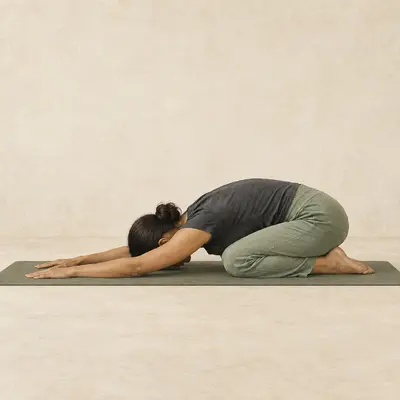
Evening Yoga to Wind Down
Settle into a slower evening sequence of folds and reclined movement, with extra time at the end to rest.
Complete beginner · 15 poses
Viśrāma (rest)Say it: vish-RAH-ma
A deeply relaxing style where the body is fully supported by bolsters, blankets and blocks — designed for rest, recovery and calm.
Restorative yoga is the art of doing almost nothing — on purpose. Each pose is propped up so completely by bolsters, blankets and blocks that your muscles can switch off. With nothing to hold up and nowhere to go, the body and mind are invited to rest deeply.
Restorative yoga uses props to fully support the body in a few simple poses held for five minutes or more. There is little or no stretch — the aim is deep rest and relaxation.
Restorative yoga grew from the teaching of B. K. S. Iyengar, who used props to help students who were ill, injured or recovering hold poses safely. His student Judith Hanna Lasater, a physical therapist, developed these supported poses into a complete style and wrote Relax and Renew (1995), which helped bring restorative yoga into studios, hospitals and wellbeing programmes worldwide.
Dim, quiet and unhurried. The teacher helps you build a comfortable nest of props for each pose so you can let go completely.
Pace: Very slow — four to six poses, each held for five to twenty minutes with full support.
Fully supported rest can lower physical tension and help shift the body out of ‘fight or flight’. Many people report better sleep and a calmer mood after a restorative class, and some studies of restorative and gentle yoga suggest benefits for stress and fatigue, though research is still developing.
Developed from B. K. S. Iyengar’s use of props and popularised by his student Judith Hanna Lasater from the 1970s onward.
Settle into a slower evening sequence of folds and reclined movement, with extra time at the end to rest.
A half-hour workday reset with repeated standing stretches and two visits to a seated twist.
Restorative poses are very gentle, but comfort is essential. Adjust props until nothing strains, avoid lying flat on your back for long periods later in pregnancy, and come out slowly — roll to your side before sitting up.
Educational guidance, not medical advice. Classes vary widely between teachers — ask about the level and pace before you join.
No. Yin creates a gentle stretch with long holds. Restorative uses props so there is little or no stretch — the purpose is rest.
Pillows, folded blankets, a sofa cushion and a wall work well as substitutes for bolsters and blocks.
Many people find an evening restorative practice helps them wind down and sleep more easily.
Even one pose for ten minutes helps. A full class usually lasts sixty to ninety minutes.