
Āyurveda · the knowledge of life
Live with the rhythm of nature.
Explore the traditional Ayurvedic ideas behind daily routines, seasonal living and the three doshas. Start with the foundations, then find small habits you can adapt to your own day.
Five elements make three doshas.
In the Ayurvedic tradition, five elements — space, air, fire, water and earth — are used to describe three doshas. These describe qualities and patterns within that tradition.
- आकाशSpaceĀkāśa
- वायुAirVāyu
- अग्निFireAgni
- जलWaterJala
- पृथ्वीEarthPṛthvī
Vata
- Qualities
- Light, cold, dry, mobile
- Traditional associations
- Restlessness, worry, dry skin, irregular digestion, poor sleep
- Traditional routine ideas
- Warmth, routine, cooked and oily foods, slow grounding practice

Pitta
- Qualities
- Hot, sharp, light, oily
- Traditional associations
- Irritability, heartburn, skin heat, perfectionism
- Traditional routine ideas
- Cooling foods, softness, time in nature, non-competitive movement

Kapha
- Qualities
- Heavy, slow, cool, steady
- Traditional associations
- Lethargy, congestion, heaviness, resistance to change
- Traditional routine ideas
- Early rising, light warm food, spices, brisk and varied exercise
Prakriti
Which blend are you?
Fifteen questions about your body, mind and habits. Get your dosha mix with food, routine and yoga ideas — in about three minutes.
Practical tools for every day.
Simple ways to bring Ayurvedic rhythm into a modern routine — no special products needed.

Daily routine
Plan your waking, meals and wind-down around the day’s natural rhythm.
Open
Seasons
See what to favour in each season so the year’s changes are easier on you.
Open
Kitchen herbs
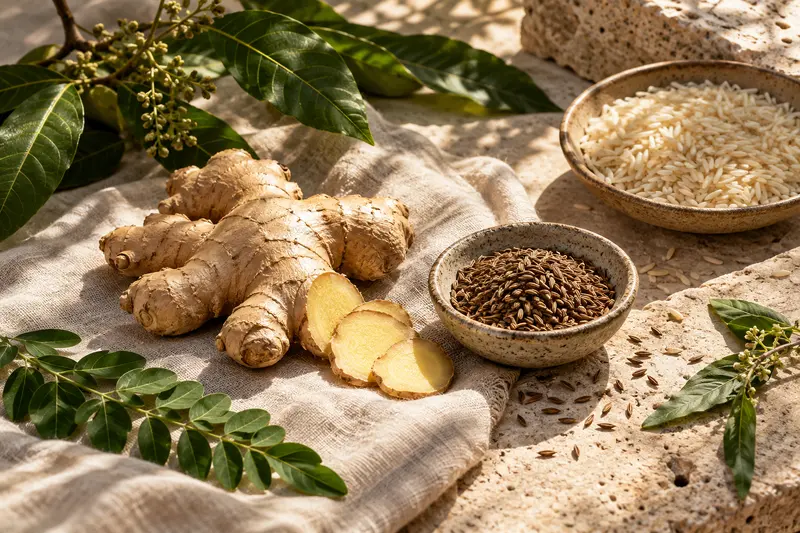
Explore the culinary uses and traditional Ayurvedic descriptions of ginger, turmeric, cumin and ghee.
Open
Dosha reflection
A gentle check-in on how each dosha shows up for you today.
OpenSix tastes on every plate.
Ayurveda groups food by taste, or rasa. Classical Ayurvedic descriptions associate each taste with particular dosha qualities. Explore the tastes, their food examples and their place in the tradition.
Sweet Madhura
Earth + water
Grains, root vegetables, ghee, dates, milk
Traditional association: Calms vata and pitta · raises kapha
Sour Amla
Earth + fire
Lemon, lime, yoghurt, fermented foods
Traditional association: Calms vata · raises pitta and kapha
Salty Lavaṇa
Water + fire
Rock salt, sea salt, seaweed
Traditional association: Calms vata · raises pitta and kapha
Pungent Kaṭu
Fire + air
Ginger, black pepper, chilli, mustard seed
Traditional association: Calms kapha · raises vata and pitta
Bitter Tikta
Air + space
Leafy greens, turmeric, bitter gourd
Traditional association: Calms pitta and kapha · raises vata
Astringent Kaṣāya
Air + earth
Lentils, pomegranate, green tea, apples
Traditional association: Calms pitta and kapha · raises vata
Agni
How Ayurveda describes digestion.
Ayurvedic texts use agni, or digestive fire, to discuss digestion and nourishment. Explore the traditional meaning of agni, then learn how meal timing and daily routines are described within Ayurveda.
Start with the foundations.
All 16 library guidesFoundationsDinacharya (Ayurvedic Daily Routine)
Ayurveda's daily routine for aligning with nature's rhythms — morning rituals, meal timing and evening habits.
FoundationsRitucharya (Seasonal Routine)
How Ayurveda adapts diet and lifestyle to each season to prevent imbalance as the weather changes.
 Foundations
Prakriti (Ayurvedic Constitution)
Your unique, lifelong mix of Vata, Pitta and Kapha — what prakriti means, how it differs from vikriti, and how it is assessed.
Ayurveda is a traditional system of medicine developed in India over thousands of years. These pages are educational. They are not a diagnosis or treatment, and they do not replace a doctor or qualified practitioner — never stop prescribed treatment based on them.