Supported Legs on a Chair
Also called Supported Legs Up, Calves on a Chair
This restorative position is a gentle alternative to Legs Up the Wall, suitable for nearly everyone.

- Hold
- 5–15 minutes
- Level
- Beginner
- Family
- Restorative, supine
- Focus
- Restorative rest
- Works
- Legs
- Lower back
- You’ll need
- Chair or sofa, Blanket
- Found in
- Hatha, Gentle
- “Legs heavy”
- “Back melting into the floor”
Step by step
How to do Supported Legs on a Chair
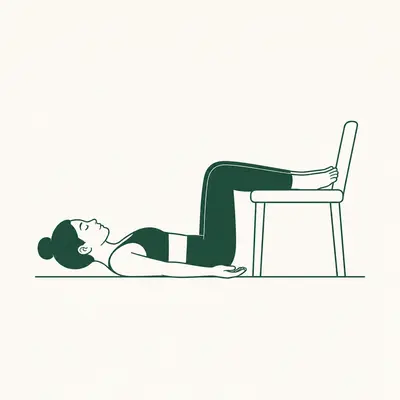
StartLie on your back in front of a chair.
- 1
Lie on your back with a chair at your feet.
- 2
Lift the legs and rest the calves on the chair seat.
- 3
Adjust so the knees and hips are both at about 90°.
- 4
Rest the arms by your sides or on the belly.
- 5
Cover yourself with a blanket and close your eyes.
- Out
Coming out. Lower the feet, roll onto your side and rest before sitting up.
Breath
Natural, relaxed breathing.
Focus
Restorative rest
Why practise it
Deeply relaxing; eases tired legs and lower back.
Go deeper
Supported Legs on a Chair: what to know
A rest that asks almost nothing
Resting the calves on a chair lets the hips and knees bend to about a right angle, and the lower back can settle toward the floor. Many people find it more comfortable than Legs Up the Wall, because the hamstrings are not stretched at all. It needs no flexibility or strength, just a clear space on the floor and a stable chair or sofa.
How to set it up
- Place a stable chair on a non-slip surface, with a mat or blanket on the floor in front
- Sit sideways next to the chair, then lower onto your side and roll onto your back
- Lift the legs and rest the calves along the seat
- Move closer or further until your hips and knees are both at about 90 degrees
- Rest your arms by your sides or on your belly, with a thin cushion under your head if you like
- Cover yourself with a blanket, close your eyes, and stay for 5 to 15 minutes
Getting the fit right
- Seat too high: fold a blanket beneath your hips, or use a lower surface
- Seat too low: add a firm cushion or folded blanket on the seat
- Too far from the chair: your legs will strain, so move closer
- Hard seat edge: lay a folded towel over it, to keep it from pressing into your calves
Legs on a Chair vs Legs Up the Wall
- Legs on a Chair: knees bent, no hamstring stretch, and often easier on the lower back
- Legs Up the Wall: legs straighter and higher, with a gentle stretch along the backs of the legs
- Both: restful, and neither requires any strength. Choose whichever you can relax in
Who should take care
After the first trimester of pregnancy, lying flat on your back may become uncomfortable, so Side-Lying Rest is usually a better choice. If you have heart problems, uncontrolled blood pressure, or reflux that gets worse when lying down, ask your clinician first. To come out, take the feet off the chair, roll to your side and pause there before sitting up, so that you do not feel lightheaded.
Alignment
Cues & common mistakes
Aim for Calves fully supported; lower back relaxed on the floor.
Teacher’s cues
- “Legs heavy”
- “Back melting into the floor”
Watch out for
Chair too far away so the legs strain.
Make it yours
Easier, harder, supported
Use cushions on the chair to adjust height.
- Legs Up the Wall
- Chair or sofa
- Blanket
In a sequence
Where it fits in a flow
 This poseSupported Legs on a Chair
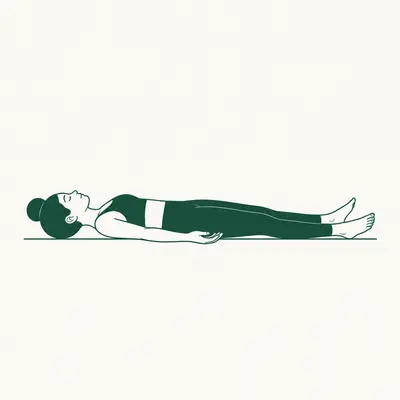 AfterCorpse Pose
Good to know
Questions
What are the benefits of putting your legs on a chair?
Many people find it relaxes the lower back and eases tired legs. It is also a comfortable way to rest quietly.
Can I do this on a sofa?
Yes, any stable surface at the right height works.
How long should I stay?
5 to 15 minutes. Even a few minutes can feel like a useful break.
Is this better than Legs Up the Wall?
It is gentler if your hamstrings are tight or your lower back is sensitive. Otherwise it comes down to which feels most restful.
Can I do it in bed?
A firm surface supports your back better, but stacked pillows under the calves can work if getting to the floor is difficult.
A restorative yoga prop variation.
What helps
Props that make this easier
- Non-slip yoga mat A 4–6 mm mat with good grip makes standing poses steadier. View on Amazon
- Cork yoga block Brings the floor closer in forward folds and supported poses. View on Amazon
- Cotton yoga strap Extends your reach in hamstring and shoulder stretches. View on Amazon
As an Amazon Associate, YogiSoul earns from qualifying purchases. Links open Amazon in your country’s store.
More restorative poses
All restorative poses
Corpse Pose
Savasana

Supported Bridge
Setu Bandha (supported)

Legs Up the Wall
Viparita Karani