
- Reflection
- Moon calendar
29 October 2026 · 85% lit
Today: Waning Gibbous
Share and give thanks. The Moon is in Gemini. Let the lunar rhythm shape your practice and reflection this week.
Coming up
Sun 1 Nov · 20:28 UTC
Last Quarter in Leo
Let go and clear space.
Mon 9 Nov · 07:02 UTC
New Moon in Scorpio
Begin quietly.
Tue 17 Nov · 11:48 UTC
First Quarter in Aquarius
Meet the challenge.
Tue 24 Nov · 14:54 UTC
Full Moon in Gemini
See clearly and release.
New and full moons for the year ahead
November 2026
December 2026
- New Moon in Sagittarius: Wednesday 9 December, 00:52 UTC
- Full Moon in Cancer: Thursday 24 December, 01:28 UTC
January 2027
February 2027
March 2027
April 2027
May 2027
June 2027
- New Moon in Gemini: Friday 4 June, 19:40 UTC
- Full Moon in Sagittarius: Saturday 19 June, 00:45 UTC
July 2027
August 2027
September 2027
October 2027
The eight phases
Begin quietly
New Moon
Keep practice soft and inward.
Take the first steps
Waxing Crescent
Add a little energy to your practice.
Meet the challenge
First Quarter
This is a good time for strength and steadiness.
Refine and persist
Waxing Gibbous
Practise with care for detail.
See clearly and release
Full Moon
Some people feel more energetic at the full moon, others more restless.
Share and give thanks
Waning Gibbous
Practise with someone else, teach a pose you love, or dedicate your practice to another person.
Let go and clear space
Last Quarter
Twists and forward folds are traditionally associated with release.
Rest and restore
Waning Crescent
Choose restorative practice, slow breathing and early nights.
The moon phases in order
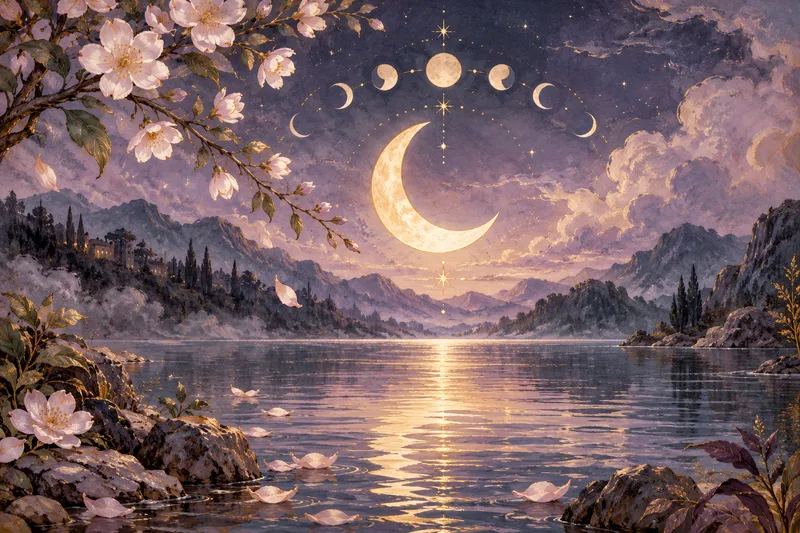
The Moon moves through eight phases in a cycle of about 29.5 days. Four are principal phases, single moments in time; the four between them each last about a week.
- New Moon: not visible; the start of the cycle and a time for intentions
- Waxing Crescent: a growing sliver in the evening sky; first steps
- First Quarter: half lit, growing; a point of effort and decision
- Waxing Gibbous: more than half lit, nearly full; patience and refinement
- Full Moon: fully lit, up all night; clarity, gratitude and release
- Waning Gibbous: still bright but shrinking; sharing and giving thanks
- Last Quarter: half lit, shrinking, seen in the morning; review and letting go
- Waning Crescent: a thin sliver before dawn; rest before the next new moon
What causes the moon’s phases?
The Moon makes no light of its own. Half of it is always lit by the Sun, just as half the Earth is always in daylight. As the Moon orbits the Earth, we see different amounts of that sunlit half: none of it when the Moon is between us and the Sun, all of it when the Moon is on the far side of the Earth. A common misconception is that the Earth’s shadow causes the phases. It doesn’t; the Earth’s shadow only falls on the Moon during a lunar eclipse.
How long is each moon phase?
One full cycle of phases, from new moon to new moon, takes 29.53 days on average. This is longer than the 27.3 days the Moon takes to orbit the Earth, because the Earth is moving around the Sun at the same time and the Moon needs about two extra days to line up with the Sun again. The new moon, first quarter, full moon and last quarter are instants, though each looks much the same for a day or so either side. The crescent and gibbous phases between them each last about seven days.
Moon phases in the northern and southern hemispheres
Everyone on Earth sees the same phase on the same night, but the view is flipped. In the northern hemisphere the Moon grows from right to left: a waxing Moon is lit on the right and a waning Moon on the left. In the southern hemisphere it is the other way round, and near the equator the crescent lies on its back like a bowl. The dates in this calendar are in UTC; in some time zones a phase falls on the previous or next calendar day.
The spiritual meaning of the moon phases
Many traditions read the lunar cycle as a rhythm for life and practice: an intention is set at the new moon, acted on as the light grows, refined as it nears fullness, seen clearly at the full moon, shared and released as the light wanes, and allowed to rest in the dark before the next beginning. The astrologer Dane Rudhyar described eight lunation phases, from new and crescent through gibbous and full to disseminating and balsamic, that many modern moon guides still use. Each phase page here offers reflection prompts, a yoga pose and a practice to match.
The Moon in yoga and the Hindu calendar
The Moon runs through yogic and Indian tradition. A popular reading of hatha yoga takes “ha” as the sun and “tha” as the moon, a practice of balancing heating and cooling, active and receptive energies. The Hindu calendar is lunar: each month is divided into 30 lunar days (tithis) across a bright fortnight (Shukla Paksha) as the Moon waxes to Purnima, the full moon, and a dark fortnight (Krishna Paksha) as it wanes to Amavasya, the new moon. Many festivals and fasts, such as Ekadashi, Guru Purnima and Diwali, follow these lunar days, and many Ashtanga Yoga communities rest on full and new moon days.
Questions
What is the moon phase today?
Today’s phase, how much of the Moon is lit and its zodiac sign are shown at the top of this page. They are recalculated every day.
How many moon phases are there?
Eight: new moon, waxing crescent, first quarter, waxing gibbous, full moon, waning gibbous, last quarter and waning crescent. Four of them (new, first quarter, full and last quarter) are the principal phases.
How long does the lunar cycle last?
About 29.5 days from one new moon to the next, which is why most months have one full moon and an occasional month has two.
Why can I see the Moon during the day?
The Moon is above the horizon for about 12 hours a day, at a different time each day. Apart from the days around the new and full moon, part of that time is in daylight, and the Moon is bright enough to see against a blue sky.
Does the Moon affect people?
The Moon clearly drives the ocean tides. For people, large studies have not found consistent effects on mood, behaviour or hospital visits, and the small sleep effects some studies report are still debated. Many people still find the lunar cycle a helpful rhythm for reflection.
What are the moon phases called in Hindi?
The waxing fortnight is Shukla Paksha (शुक्ल पक्ष) and the waning fortnight is Krishna Paksha (कृष्ण पक्ष). The full moon is Purnima (पूर्णिमा) and the new moon is Amavasya (अमावस्या).
Times are calculated for the whole Earth in Coordinated Universal Time (UTC); convert to your local time zone, which can move a phase to the previous or next calendar day. The Moon’s sign uses the Western tropical zodiac. Lunar phases are offered here as a rhythm for reflection and practice, not as predictions.