उत्थित पार्श्वकोणासन
Extended Side Angle
Extended Side Angle creates one long line from the back heel to the fingertips while building strength in the legs.

- Hold
- 5–8 breaths per side
- Level
- Beginner
- Family
- Standing, standing
- Focus
- Side-body length
- Works
- Legs
- Hips
- Side body
- Shoulders
- You’ll need
- Block
- Found in
- Hatha
- “One long line, heel to hand”
- “Chest turns up”
- “Front knee presses into arm”
Step by step
How to do Extended Side Angle
StartBegin in Warrior II.
- 1
From Warrior II (right knee bent), lower the right forearm onto the right thigh.
- 2
Or place the right hand on a block or the floor outside the foot.
- 3
Extend the left arm overhead alongside the ear.
- 4
Create one line from the back foot to the top fingertips.
- 5
Rotate the chest toward the ceiling.
- 6
Gaze up or forward.
- Out
Coming out. Inhale, rise back to Warrior II and switch sides.
Breath
Breathe into the top side of the ribcage.
Focus
Side-body length
Why practise it
Strengthens legs; stretches side body, hips and shoulders.
Go deeper
Extended Side Angle: what to know
Length before depth
The aim of Extended Side Angle is one long line from the outer edge of the back foot to the fingertips of the top arm. Reaching the bottom hand to the floor often costs that line, because the chest drops and the top shoulder rolls forward. Resting the forearm on the thigh or the hand on a block keeps the side body long, which is where most of the stretch comes from.
How to do Extended Side Angle
- Start in Warrior II with the right knee bent over the ankle
- Reach the right arm forward, then lower the right forearm to the right thigh, or the right hand to a block outside the right foot
- Keep the right knee pointing towards the little-toe side of the foot
- Press the outer edge of the left foot down and reach the left arm up, then over the left ear
- Turn the chest towards the ceiling and gaze up, forward or down, whichever is comfortable for the neck
- Hold for 5 to 8 breaths, press up through the front foot to return to Warrior II and switch sides
Common mistakes
- Leaning heavily on the forearm, which collapses the chest; keep only light weight in it
- The front knee falling inward past the big toe
- The back foot lifting on its outer edge
- The top arm drifting in front of the face, which rounds the shoulder forward
Making it work for you
Keep the top hand on the hip if the shoulder is tight or injured. Shorten the stance if the front knee cannot bend towards 90 degrees. Look down at the floor if turning the head is uncomfortable for the neck. A block in any position is a sensible choice, not a lesser version.
Alignment
Cues & common mistakes
Aim for Front knee over ankle; chest open; back foot grounded.
Teacher’s cues
- “One long line, heel to hand”
- “Chest turns up”
- “Front knee presses into arm”
Watch out for
Collapsing onto the forearm and letting the front knee fall inward.
Make it yours
Easier, harder, supported
Forearm on thigh; top hand on hip.
- Bound Side Angle
- Revolved Side Angle
- Block
In a sequence
Where it fits in a flow
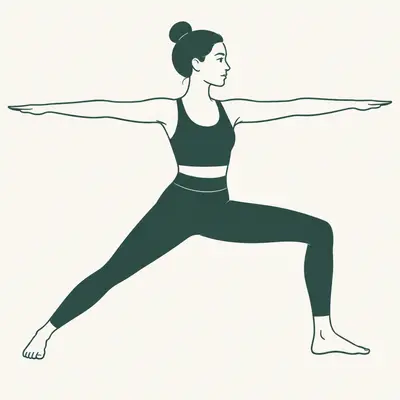 BeforeWarrior II
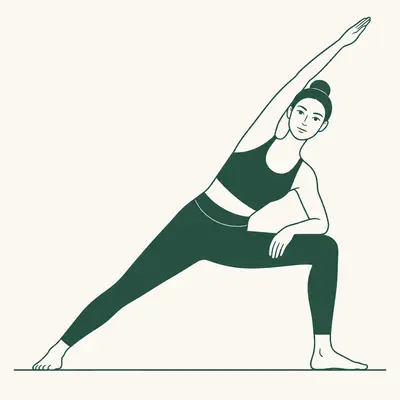 This poseExtended Side Angle
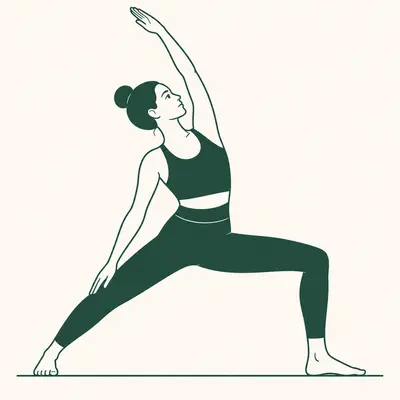 AfterReverse Warrior
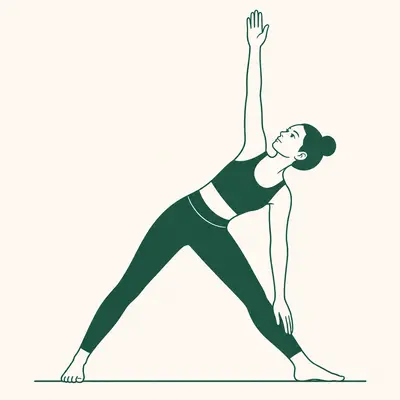 AfterTriangle Pose
 AfterHalf Moon
Good to know
Questions
What is Extended Side Angle good for?
Strengthening the legs and glutes, and stretching the side body, hips, groin and shoulders.
Should my hand be on the floor in Extended Side Angle?
Only if the chest can stay open. A forearm on the thigh or a hand on a block is often a better pose.
Where should I look in Extended Side Angle?
Traditionally up under the top arm, but forward or down is fine if the neck feels strained.
How long should I hold Extended Side Angle?
5 to 8 breaths per side, or up to a minute when building strength.
What is the difference between Extended Side Angle and Triangle?
In Extended Side Angle the front knee is bent; in Triangle both legs are straight.
Popularised in the Iyengar and Ashtanga traditions.
What helps
Props that make this easier
- Non-slip yoga mat A 4–6 mm mat with good grip makes standing poses steadier. View on Amazon
- Cork yoga block Brings the floor closer in forward folds and supported poses. View on Amazon
- Cotton yoga strap Extends your reach in hamstring and shoulder stretches. View on Amazon
As an Amazon Associate, YogiSoul earns from qualifying purchases. Links open Amazon in your country’s store.
More standing poses
All standing poses
Mountain Pose
Tadasana

Warrior II
Virabhadrasana II

Chair Pose
Utkatasana