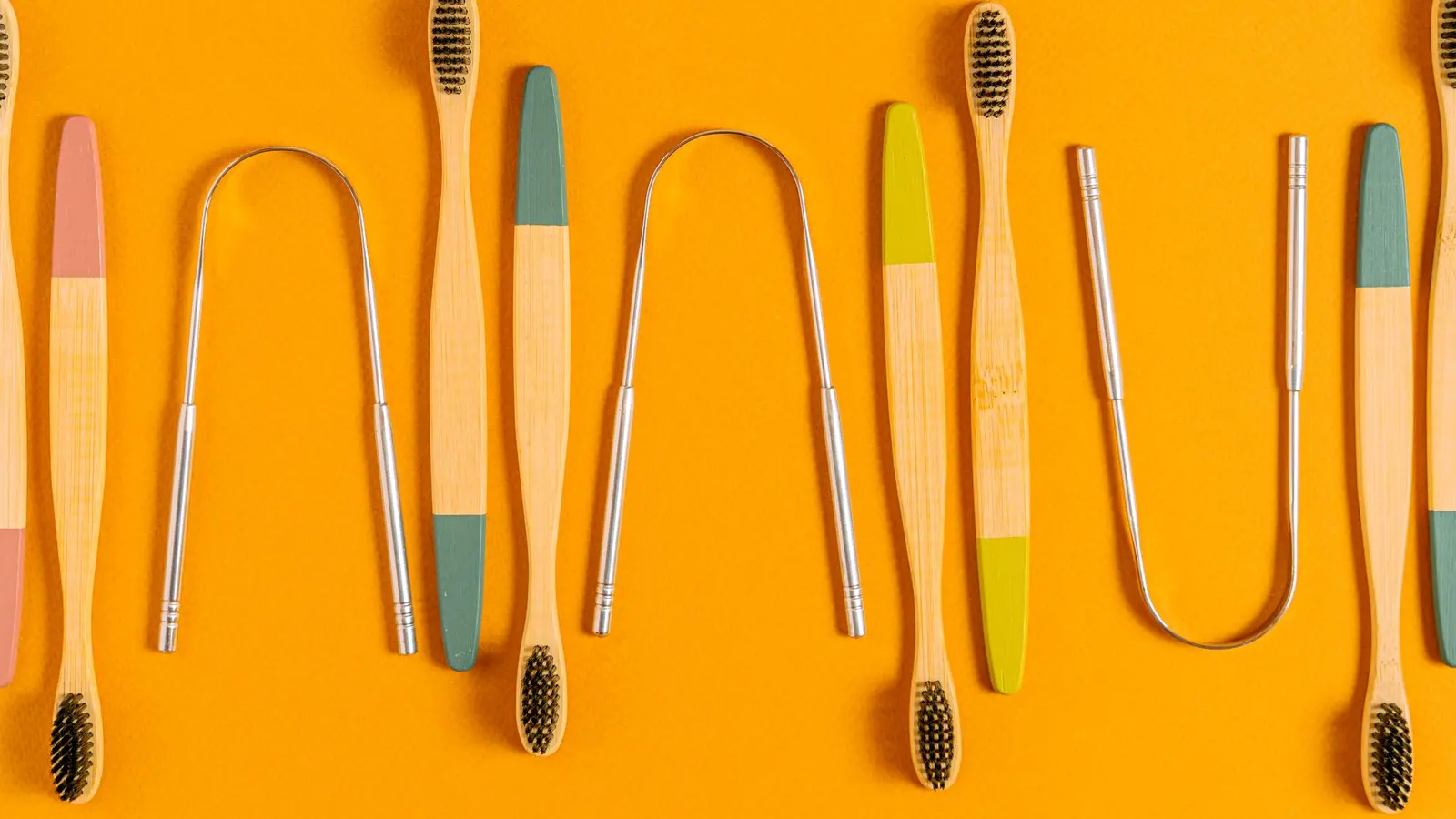
Tongue scraping means gently drawing a smooth, curved tool over the surface of your tongue to lift off the soft coating that builds up there. It takes less than a minute, usually first thing in the morning. It has been part of the Ayurvedic daily routine for centuries, and today many people use it to freshen their breath.
The research is more modest than the claims you may see online. Scraping can reduce tongue coating and may help with morning breath for a short time, but it does not replace brushing, flossing or a visit to the dentist. This guide explains how to do it, what it can and cannot do, and how to choose a scraper.
What is on your tongue?
The top of the tongue is not smooth. It is covered in tiny bumps called papillae, and bacteria, food debris and dead cells collect between them. This can form a visible white or yellowish coating, usually thickest towards the back of the tongue.
Some of those bacteria produce sulphur compounds with a strong smell, and the tongue coating is considered a common source of bad breath. That is the main reason people clean it.
How to scrape your tongue
- Rinse your scraper. Start with a clean tool and clean hands.
- Open your mouth and relax your tongue. Stick it out a little. A mirror helps at first.
- Place the scraper towards the back. Go only as far back as you can without gagging. Over time this may become easier.
- Draw it forward gently. Pull the scraper from back to tip in one smooth stroke, using light pressure.
- Rinse the scraper. Wash away what it has collected.
- Repeat a few times. Two to five strokes are usually enough, covering the left, middle and right of the tongue.
- Rinse your mouth, then wash and dry the scraper.
Scrape in one direction only, from back to front. Pressing harder does not clean any better, and it may irritate your tongue.
Tongue scraping benefits: what the evidence says
| Claim | What we can say |
|---|---|
| Removes tongue coating | Yes, this is what the tool is designed to do, and you can see the result |
| Freshens breath | Possibly, for a short time. A 2006 Cochrane review found only small, weak evidence that scrapers or cleaners help with bad breath in the short term |
| Improves taste | Some small studies suggest it may help, but the evidence is limited |
| Removes toxins | Not established. The idea comes from traditional Ayurvedic teaching, not modern research |
| Boosts digestion or immunity | Not established. Don't rely on scraping for either |
| Replaces brushing | No. Scraping cleans only the tongue, and does nothing for plaque on your teeth |
Long-lasting bad breath often has another cause, such as gum disease, dry mouth, sinus problems or reflux. If it does not improve with good oral care, see a dentist.
Tongue scraping in Ayurveda
In Ayurveda, tongue cleaning is called jihva nirlekhana (jihvā means tongue). It belongs to dinacharya, the daily routine that sets the tone for the morning. Classical texts such as the Charaka Samhita recommend a soft, curved scraper made of metal.
Traditional teaching sees the morning coating as a sign of ama, undigested residue, and treats the tongue as a mirror of digestion. These are ideas from a traditional system, not findings from clinical research. Many people still value the ritual simply because it starts the day with a small act of care.
When to scrape your tongue
- In the morning. Most people scrape once a day, after waking and before eating or drinking. The tongue often has the most coating at this time.
- Before or after brushing. Either works. Choose whichever is easiest to remember.
- Once a day is enough. If your tongue feels sore, cut back or take a break.
Choosing a tongue scraper
| Type | Good points | Things to consider |
|---|---|---|
| Stainless steel | Durable, easy to clean, inexpensive | Check that its edges are smooth |
| Copper | The traditional choice, naturally tarnishes | Needs regular cleaning, and should be avoided with a copper allergy |
| Plastic | Light, cheap and gentle | Wears out, so needs replacing more often |
| Toothbrush | You already have one | Less direct, though a soft brush is a reasonable option |
There is no strong evidence that one material works better than another. Choose a smooth, rounded scraper that you find comfortable, and replace it if it becomes rough or damaged.
Who should take care
- A strong gag reflex. Start nearer the tip, breathe out as you scrape, and move back slowly over time.
- Sores or cuts. Wait until any ulcer, cut or new piercing has healed. Stop if your tongue bleeds.
- Persistent changes. See a dentist or doctor about any white or red patch, lump, or sore that lasts more than two weeks. Don't try to scrape it away.
- Thrush or a sore, burning tongue. Get it checked before scraping, as a coating may need treatment.
- Young children. Ask your dentist first.
A simple morning routine
Tongue scraping fits easily into a short morning routine:
- Scrape your tongue and rinse your mouth.
- Brush your teeth.
- Drink a glass of water.
- Take a few minutes for gentle movement, or a round of Sun Salutation.
- Sit quietly for a few slow breaths before the day begins.
Questions
Is tongue scraping actually good for you?
It is a low-risk way to remove tongue coating, and it may freshen your breath for a short time. The evidence for wider health benefits is weak, so think of it as an extra step alongside brushing and flossing.
Is it better to scrape or brush your tongue?
Both can clean the tongue. A scraper is flatter and may feel easier with a strong gag reflex, while a toothbrush is already in your bathroom. Either is reasonable if you are gentle.
How often should you scrape your tongue?
Once a day, usually in the morning, is what most people do. Cut back if your tongue feels sore.
Can tongue scraping damage your tongue?
It can irritate your tongue if you press too hard or use a rough tool. Use light pressure and a smooth scraper, and stop if you notice soreness or bleeding.
Does tongue scraping remove toxins?
There is no good evidence that it does. It removes bacteria, debris and dead cells from the surface of your tongue. The idea of removing toxins comes from traditional teaching.
Is copper better than stainless steel?
Copper is the traditional choice, but there is no strong evidence that it works better. Stainless steel is durable and easy to look after.
Why is my tongue still white after scraping?
A light coating is normal and tends to return. If your tongue stays thickly coated, is sore, or has patches that last more than two weeks, ask a dentist or doctor to check it.
Updated 4 November 2026 by the YogiSoul editorial team. Read our editorial policy and wellness policy.